
Services
Traffic Impact Analysis
Civotec provides traffic engineering studies to support safe, efficient, and well-planned development. Our services include Traffic Impact Analysis (TIA) and Traffic Impact Studies (TIS) for private developments and public infrastructure projects.
Traffic Impact Studies / Traffic Impact Analyses (TIA)
Traffic Impact Analyses (TIAs) evaluate how a proposed development will affect the surrounding roadway network. At Civotec, we prepare TIAs in compliance with municipal and TxDOT guidelines, addressing vehicle volumes, access, and operational performance. Our reports support permitting and zoning approvals by providing clear, data-backed assessments and mitigation recommendations when needed.
Trip Generation & Distribution
Using the latest ITE Trip Generation Manual and project-specific data, we estimate the volume of traffic expected to be generated by a development. Our team then applies logical trip distribution and assignment models—such as the Fratar method or manual distribution—to project traffic patterns and assess downstream impacts on intersections and corridors.
Signal Warrant Studies
We conduct signal warrant studies in accordance with MUTCD Chapter 4C to determine if traffic signals are justified at unsignalized intersections. These studies consider criteria such as volume thresholds, crash history, pedestrian activity, and school proximity. Our analyses are tailored to local agency requirements and are often essential for new developments or access changes.
Access & Circulation Studies
Civotec evaluates driveway locations, site access spacing, internal circulation, and interaction with adjacent roadways to ensure safe and efficient site design. We assist developers and engineers in refining site plans to meet access management guidelines while optimizing vehicular, pedestrian, and service vehicle movement.
Crash & Safety Analysis
We perform crash data evaluations and safety assessments to identify high-risk intersections or corridors. Using publicly available crash data and field observations, we assess contributing factors and recommend targeted countermeasures such as geometric improvements, control changes, or signal modifications to improve overall roadway safety.
Expert Witness Support
Civotec offers expert consulting and litigation support in traffic-related cases. Whether evaluating the adequacy of roadway design, control devices, visibility, or crash causation, we provide clear, defensible analysis and expert testimony to assist attorneys, insurers, and public agencies in resolving disputes.
Civotec specializes in traffic engineering studies that support safe, efficient, and well-planned infrastructure. We provide data-driven analyses tailored to each project’s needs—whether for private development, public infrastructure, or permitting compliance. Our team utilizes field data collection, trip generation modeling, and traffic simulation tools to evaluate roadway performance, access, and safety. From traffic impact analyses to signal warrant studies, we deliver clear, defensible reports that help clients move projects forward with confidence.
Traffic Impact Analysis Frequently Asked Questions
There is no technical difference. “Traffic Impact Study” and “Traffic Impact Analysis” are used interchangeably by agencies to describe the same traffic evaluation process.
TIA requirements depend on project location, trip generation, and roadway jurisdiction. An initial screening or technical memorandum is often used to confirm whether a full Traffic Impact Analysis is required. Civotec routinely performs this applicability review. For screening and preparing a technical memorandum contact Civotec at info@civotec.com.
Traffic Impact Studies are typically reviewed by the agency or agencies with jurisdiction over the affected roadways. Reviewing authorities commonly include cities or municipalities, counties or regional agencies, and state Departments of Transportation (DOT). Depending on project location, access points, and traffic impacts, some developments may require joint review and coordination among multiple agencies.
For low-impact developments, some agencies may accept a Technical Memorandum or abbreviated traffic analysis instead of a full Traffic Impact Analysis. Acceptance depends on trip generation levels, access conditions, and agency discretion.
DOT review is typically required when a development directly accesses or impacts a state-maintained highway, frontage road, interchange ramp, or other state-controlled facility. Even when a city or county serves as the primary reviewing agency, coordination with the Department of Transportation (DOT) may still be required depending on roadway jurisdiction, access location, and the extent of traffic impacts. Please note that Traffic Impact Analysis and DOT review requirements vary by state and jurisdiction. Specific thresholds, review responsibilities, and coordination procedures differ among state Departments of Transportation and local agencies. Project-specific confirmation with the applicable reviewing authority is recommended to determine exact study and review requirements.
Timeframes vary based on study complexity and agency review cycles. An initial applicability review may take only a few days, while a full Traffic Impact Analysis typically takes several weeks, including agency comments and revisions.
Typical inputs include a site plan, proposed land use details, anticipated opening year, and access locations. Civotec can assist with trip generation estimates and data requirements early in the process.
In some cases, agencies may accept a previously approved Traffic Impact Study if conditions have not materially changed. This determination is agency-specific and often requires confirmation through coordination.
If deficiencies are identified, the study will recommend mitigation measures such as turn lanes, signal timing adjustments, access modifications, or other improvements needed for agency approval.
Yes. Civotec can coordinate with cities, counties, and DOT’s throughout the Traffic Impact Analysis process, including scope confirmation, submittals, and responses to agency comments.
Costs vary depending on project size, study complexity, and agency requirements. A small technical memorandum or initial applicability review typically costs less than a full Traffic Impact Analysis. Full Traffic Impact Analysis, which include data collection, modeling, and agency submittals, are priced based on scope and study limits. Contact Civotec at info@civotec.com for a tailored cost estimate based on your project details.
Traffic Impact Analysis Overview
What Is a Traffic Impact Study and Why Is It Important?
A Traffic Impact Study (TIS), also commonly referred to as a Traffic Impact Analysis (TIA), is a technical study that evaluates how a proposed development may affect the surrounding roadway network. The study estimates the number of trips generated by a project, identifies how those trips distribute across nearby streets and intersections, and assesses whether existing or planned transportation infrastructure can safely and efficiently accommodate the additional traffic.
Traffic Impact Studies are commonly required by reviewing agencies such as cities, counties, state Departments of Transportation (DOT), and other roadway authorities when a development exceeds specific trip generation or size thresholds. The purpose of a Traffic Impact Study is not only to quantify traffic impacts, but also to identify necessary mitigation measures, such as roadway improvements, signal timing adjustments, access modifications, or turn lane additions, to maintain acceptable traffic operations and safety. A well-prepared Traffic Impact Study helps ensure that development projects move forward without creating congestion, safety concerns, or operational deficiencies. It also provides reviewing agencies with the technical documentation needed to make informed permitting and access decisions. For developers, completing a Traffic Impact Study early in the project lifecycle reduces the risk of delays, redesigns, or unexpected infrastructure costs during agency review.
When a Traffic Impact Analysis Is NOT Required
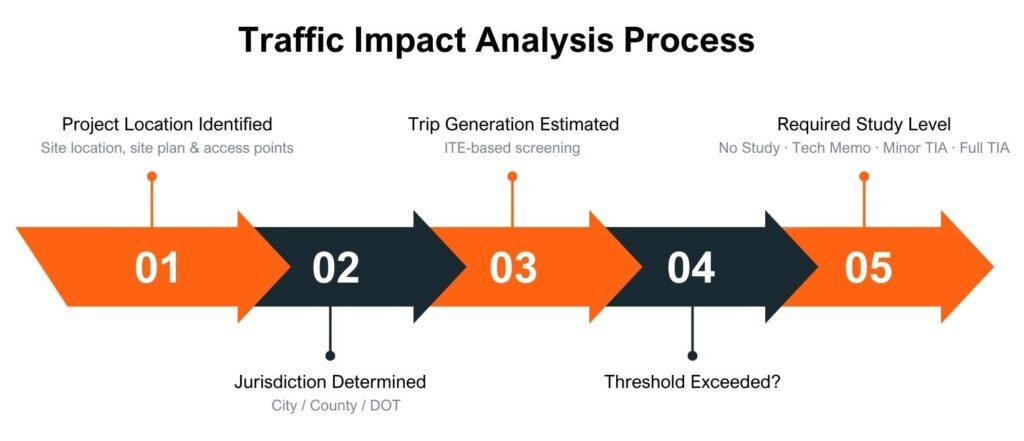
A Traffic Impact Analysis is not required for every development. Many projects generate low traffic volumes or qualify for exemptions based on agency-specific criteria. In such cases, the reviewing authority may determine that a full Traffic Impact Study is unnecessary. Common situations where a Traffic Impact Study may not be required include small developments with minimal trip generation, minor tenant finish-outs, changes in land use with no net increase in traffic, or projects that fall below established agency thresholds. Some agencies may also waive the requirement when existing traffic studies adequately address the proposed development. Because requirements vary by jurisdiction, an initial Traffic Impact Analysis applicability review is often recommended to confirm whether a study is required by the reviewing city, county, state Department of Transportation (DOT), or other roadway authority. Early confirmation helps avoid unnecessary studies and reduces the risk of delays during the permitting and review process.
Technical Memorandum vs. Minor vs. Full Traffic Impact Analysis
Traffic study requirements vary by jurisdiction, and not all reviewing agencies formally define multiple levels of Traffic Impact Analysis. In many cases, the reviewing authority determines the appropriate level of analysis based on project-specific impacts rather than fixed study categories. A Technical Memorandum or abbreviated analysis is commonly accepted for low-impact developments with limited trip generation and localized effects. Some agencies may require a Minor Traffic Study for moderate-impact projects, particularly those accessing or affecting state-maintained roadways. These studies typically include a focused evaluation of peak-hour operations and safety but are more limited in scope than a full TIA. A Full Traffic Impact Analysis (TIA) is required when a development exceeds agency thresholds or creates broader operational or safety impacts. Full TIAs evaluate existing and future conditions, traffic distribution and assignment, intersection and roadway operations, and required mitigation measures. The required study level is determined by agency policies, roadway jurisdiction, and project characteristics. Early coordination with the reviewing agency is recommended to confirm scope and documentation requirements and to avoid delays during the permitting and review process.
Which Agency Reviews Your Development?
The agency that reviews a Traffic Impact Study depends on the project location, roadway jurisdiction, and site access points. This determination is typically made by identifying municipal boundaries, county jurisdiction, and whether the development connects to a state-maintained roadway.
The reviewing agency can usually be identified using the following steps:
- Confirm whether the site is within an incorporated city: If the project is located within the corporate limits of a city or municipality, that city is typically the primary reviewing agency for the Traffic Impact Analysis.
- Determine whether the site is outside city limits but within a county jurisdiction: Developments located outside incorporated cities are generally reviewed by the applicable county or regional authority.
- Evaluate whether the development impacts a state-maintained roadway: If site access is provided from a state highway, frontage road, interchange ramp, or other state-controlled facility, review by the state Department of Transportation (DOT) is typically required, either as the primary agency or in coordination with the local jurisdiction.
- Identify overlapping or joint jurisdiction cases: Some developments require coordination with multiple reviewing agencies, such as a city and a DOT, or a county and a DOT, depending on access location and traffic impacts.
- Confirm requirements through agency coordination when needed: For projects near jurisdictional boundaries or with complex access conditions, direct coordination with the reviewing agency is often necessary to confirm Traffic Impact Analysis requirements and documentation expectations.
How can we help?
Submit your project details to receive a tailored traffic engineering proposal with a typical turnaround of one business day.