
Dallas-Fort Worth Region Traffic Impact Study and Analysis Requirements
What Is a Traffic Impact Study and Why Is It Important in Dallas?
A Traffic Impact Study (TIS)—also commonly referred to as a Traffic Impact Analysis (TIA)—is a technical evaluation of how a proposed development will affect the surrounding roadway network. In Dallas, Texas, a TIA assesses the number of trips generated by a project, how those trips distribute across nearby streets and intersections, and whether existing or planned transportation infrastructure can safely and efficiently accommodate the additional traffic.
In the Dallas metropolitan area, Traffic Impact Studies are commonly required by reviewing agencies such as the City of Dallas, surrounding municipalities, county agencies, the North Central Texas Council of Governments (NCTCOG), and the Texas Department of Transportation (TxDOT) when a development exceeds defined trip generation thresholds, impacts roadway access, or meets specific size or land-use criteria. These requirements help ensure that new development in Dallas does not negatively affect traffic operations, safety, or long-term mobility.
The purpose of a Traffic Impact Analysis in Dallas is not only to quantify traffic impacts, but also to identify appropriate mitigation measures—such as intersection improvements, signal timing modifications, access management changes, or additional turn lanes—to maintain acceptable traffic operations and safety. A well-prepared Traffic Impact Study supports informed permitting and access decisions by reviewing agencies and helps development projects move forward without creating congestion, safety concerns, or operational deficiencies. For developers in Dallas, completing a Traffic Impact Study early in the project lifecycle reduces the risk of review delays, redesigns, or unexpected infrastructure costs during agency coordination.
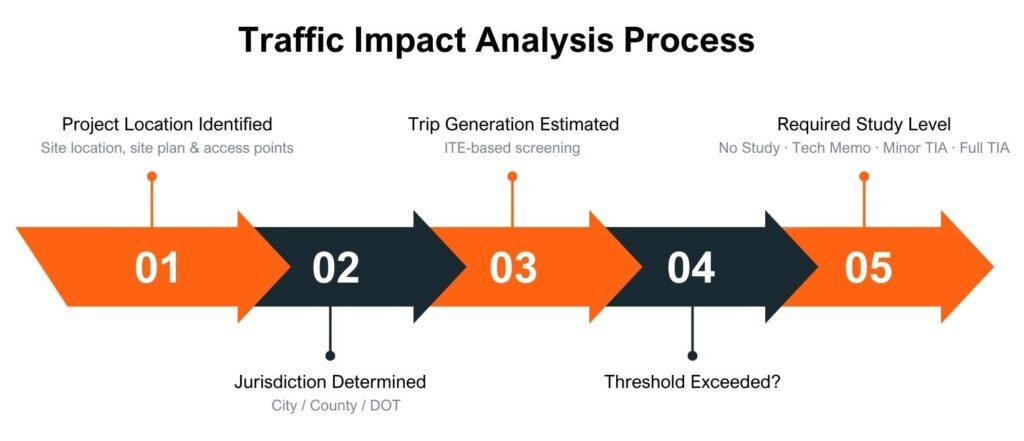
Which Agency Reviews Your Development in Dallas?
The agency responsible for reviewing a Traffic Impact Study (TIS) in Dallas depends on the project location, roadway ownership, and site access conditions. In Dallas, Texas, this determination is typically made by confirming municipal boundaries, county jurisdiction, and whether the proposed development connects to a TxDOT-maintained roadway. Identifying the correct reviewing agency early is an important step in the Dallas Traffic Impact Analysis (TIA) process and helps avoid delays during permitting.
The appropriate reviewing agency for a Traffic Impact Analysis in Dallas can usually be identified using the following steps:
- Confirm whether the site is within the City of Dallas or another incorporated city: If the project is located within the corporate limits of the City of Dallas or nearby cities such as Fort Worth, Plano, Frisco, or Arlington, that municipality is typically the primary reviewing agency for the Traffic Impact Analysis.
- Check if the site is outside city limits but within county jurisdiction: Developments located outside incorporated city boundaries in the Dallas–Fort Worth region are generally reviewed by the applicable county—such as Dallas County, Tarrant County, Collin County, or Denton County—depending on project location and roadway ownership.
- Determine whether the development impacts a TxDOT roadway: If site access is provided from a state highway, frontage road, interchange ramp, or other facility maintained by the Texas Department of Transportation (TxDOT), TxDOT review is typically required, either as the primary reviewing agency or in coordination with the City of Dallas or the applicable county.
- Identify overlapping or joint jurisdiction cases in Dallas: Some developments in the Dallas area require coordination between multiple agencies—such as the City of Dallas and TxDOT or a county and TxDOT—depending on roadway jurisdiction, access location, and the extent of projected traffic impacts.
- Confirm Traffic Impact Analysis requirements through agency coordination when needed: For projects near city limits, within extraterritorial jurisdictions (ETJs), or involving complex access conditions, direct coordination with the reviewing agency is commonly used to confirm Dallas TIA requirements, study scope, and documentation expectations.
Traffic Impact Analysis Requirement per Agency
| Agency or Jurisdiction | TIA Threshold | Notes |
|---|---|---|
| City of Dallas | 100+ peak trips | Projects exceeding 100+ peak trips or 2,000+ daily trips may qualify for a TIA waiver and require coordination with Dallas DOT. |
| Fort Worth | Varies by zone | Traffic study needs vary by zone and emphasize Blue Zone coordination, multimodal considerations, and TPW review. |
| City of Plano | 100+ peak trips | Developments meeting the 100+ peak trip level are reviewed under the 2024 guidelines and may require a PTIS through the Engineering Department. |
| City of Frisco | Site specific | Traffic study requirements are defined through a required scoping meeting with Development Services, with fast-track options available. |
| City of Arlington | 100+ peak trips | Projects generating 100+ peak trips may submit either a TIS or TIA and must coordinate review with the Planning Department and TxDOT. |
| City of Irving | 100+ peak trips | Projects exceeding 100+ peak trips are reviewed by the Traffic Department with standard requirements and transit coordination. |
| TxDOT Dallas District | State highway access | Developments affecting state highway access require an engineering study or TIA with access management and district coordination. |
| City of Garland | Development specific | Traffic study needs are determined on a case-by-case basis with Engineering review and DART coordination. |
| City of McKinney | 50+ peak trips | Traffic review may be required starting at 50+ peak trips due to lower thresholds and rapid growth, subject to Engineering review. |
| City of Richardson | 100+ peak trips | Developments generating 100+ peak trips require a TIA with Development Services review and NCTCOG coordination. |
TIA DFW Frequently Asked Questions
There is no technical difference. “Traffic Impact Study” and “Traffic Impact Analysis” are used interchangeably by agencies in the Dallas-Fort Worth region to describe the same traffic evaluation process.
TIA requirements depend on project location, trip generation, and roadway jurisdiction. An initial screening or technical memorandum is often used to confirm whether a full Traffic Impact Analysis is required. Civotec routinely performs this applicability review. For screening and preparing a technical memorandum contact Civotec at info@civotec.com.
Reviewing agencies in the Dallas–Fort Worth (DFW) region commonly include municipal transportation or engineering departments—such as those of Dallas, Fort Worth, Plano, Frisco, Arlington, and Irving, as well as county agencies (e.g., Dallas County, Tarrant County, Collin County, and Denton County) and the Texas Department of Transportation (TxDOT). Depending on roadway jurisdiction, access location, and traffic impacts, some projects may require joint review by multiple agencies, such as a city and TxDOT or a county and TxDOT.
For low-impact developments, some agencies may accept a Technical Memorandum or abbreviated traffic analysis instead of a full Traffic Impact Analysis. Acceptance depends on trip generation levels, access conditions, and agency discretion.
TxDOT review is typically required when a project accesses or impacts a state highway, frontage road, or ramp system. Even if a city or county is the primary reviewer, TxDOT coordination may still be necessary.
Timeframes vary based on study complexity and agency review cycles. An initial applicability review may take only a few days, while a full Traffic Impact Analysis typically takes several weeks, including agency comments and revisions.
Typical inputs include a site plan, proposed land use details, anticipated opening year, and access locations. Civotec can assist with trip generation estimates and data requirements early in the process.
In some cases, agencies may accept a previously approved Traffic Impact Study if conditions have not materially changed. This determination is agency-specific and often requires confirmation through coordination.
If deficiencies are identified, the study will recommend mitigation measures such as turn lanes, signal timing adjustments, access modifications, or other improvements needed for agency approval.
Yes. Civotec can coordinate with cities, counties, and TxDOT throughout the Traffic Impact Analysis process, including scope confirmation, submittals, and responses to agency comments.
Costs vary depending on project size, study complexity, and agency requirements. A small technical memorandum or initial applicability review typically costs less than a full Traffic Impact Analysis. Full Traffic Impact Analysis, which include data collection, modeling, and agency submittals, are priced based on scope and study limits. Contact Civotec at info@civotec.com for a tailored cost estimate based on your project details.
When a Traffic Impact Analysis Is NOT Required in Dallas
A Traffic Impact Analysis (TIA) is not required for every development in Dallas, Texas, or across the broader Dallas–Fort Worth (DFW) region. Many projects within the City of Dallas generate relatively low traffic volumes or qualify for exemptions under city or agency-specific criteria. In these cases, the reviewing authority may determine that a full Traffic Impact Study (TIS) is unnecessary.
In Dallas, common situations where a Traffic Impact Study may not be required include small developments with minimal trip generation, minor tenant finish-outs, changes in land use that result in no net increase in traffic, or projects that fall below established City of Dallas TIA thresholds. In some instances, the requirement may also be waived when an existing or previously approved traffic study adequately addresses the proposed development and surrounding roadway conditions.
Because Traffic Impact Analysis requirements in Dallas vary by jurisdiction, an initial TIA applicability review is often recommended to confirm whether a study is required by the City of Dallas, the applicable county, or the Texas Department of Transportation (TxDOT). Early confirmation helps developers avoid unnecessary traffic studies, reduce permitting delays, and minimize the risk of unexpected redesigns or infrastructure costs during the Dallas development review process.
Technical Memorandum vs. Minor vs. Full Traffic Impact Analysis in Dallas
Traffic study requirements in Dallas, Texas, and throughout the Dallas–Fort Worth (DFW) region vary by jurisdiction, and not all reviewing agencies formally define multiple levels of Traffic Impact Analysis (TIA). In many cases, the appropriate level of analysis is determined by the reviewing authority—such as the City of Dallas or the Texas Department of Transportation (TxDOT)—based on project-specific traffic impacts rather than fixed study categories.
For low-impact developments in Dallas with limited trip generation and localized effects, a Technical Memorandum or other abbreviated traffic analysis is commonly accepted. These submittals are often used for small developments, minor site changes, or projects that do not significantly affect nearby intersections or roadway operations.
Some agencies in the DFW area, particularly when a project accesses or impacts TxDOT-maintained roadways, may require a Minor Traffic Study for moderate-impact developments. Minor traffic studies typically focus on peak-hour operations, access conditions, and safety considerations, but are narrower in scope than a full Traffic Impact Analysis.
A Full Traffic Impact Analysis (TIA) is generally required in Dallas when a development exceeds established agency thresholds or results in broader operational or safety impacts. Full TIAs evaluate existing and future traffic conditions, trip distribution and assignment, intersection and roadway capacity, and identify necessary mitigation measures such as turn lanes, signal improvements, or access modifications.
The required traffic study level for a Dallas Traffic Impact Analysis is determined by agency policies, roadway jurisdiction, and specific project characteristics. Early coordination with the City of Dallas, applicable counties, or TxDOT, and when relevant the North Central Texas Council of Governments (NCTCOG), is strongly recommended to confirm study scope and documentation requirements and to avoid delays during the Dallas development permitting and review process.
Steps of a Traffic Impact Analysis in Dallas-Fort Worth Region
A Traffic Impact Analysis (TIA) in Dallas, Texas is typically completed in two main steps. The first step determines whether a full or minor Traffic Impact Analysis is required based on City of Dallas, county, or TxDOT criteria and the specific characteristics of the proposed development. If a study is required, the second step involves completing a Traffic Impact Analysis in accordance with applicable agency standards and review procedures used in the Dallas–Fort Worth (DFW) region.
Step 1: Initial Traffic Impact Review (TIA Applicability in Dallas)
The initial step of a Dallas Traffic Impact Analysis focuses on confirming whether a development triggers a formal traffic study requirement.
- Preliminary assessment of Dallas TIA requirements: Applicable Traffic Impact Analysis requirements are reviewed based on project location to identify the governing agency—such as the City of Dallas, the applicable county, or the Texas Department of Transportation (TxDOT)—and any relevant thresholds.
- Initial trip generation calculations: Site-generated traffic is estimated using accepted methodologies, including the ITE Trip Generation Manual, to evaluate the potential traffic impacts of the proposed development on the Dallas roadway network.
- Determination of required study level: Based on trip generation results and agency criteria, it is determined whether a limited analysis is sufficient or if a minor or full Traffic Impact Analysis (TIA) or Traffic Impact Study (TIS) is required for the Dallas project.
- Coordination with the reviewing agency (as needed): When clarification is required, coordination with the reviewing agency is performed to confirm study scope, documentation requirements, and expectations early in the Dallas development review process.
Step 2: Full Traffic Impact Analysis (If Required in Dallas)
If a full Traffic Impact Analysis is required in Dallas, the following steps are typically completed.
- TIA scoping and contracting: The Traffic Impact Analysis scope, study limits, and analysis requirements are defined based on agency standards and project characteristics applicable in the Dallas area.
- Traffic data collection: Traffic volume counts and operational data are collected at study intersections and roadways to support the Dallas Traffic Impact Analysis.
- Traffic analysis and TIA report preparation: Existing and future traffic conditions are analyzed, and a Traffic Impact Analysis report is prepared in accordance with City of Dallas, county, or TxDOT guidelines, and when applicable coordinated with the North Central Texas Council of Governments (NCTCOG).
- Agency submittals and review: The completed Traffic Impact Analysis is submitted to the reviewing agency, and the formal Dallas traffic review process is initiated.
- Agency comments and responses: Agency review comments are addressed, and the Traffic Impact Analysis is revised as required to obtain approval and support project permitting in Dallas.
Disclaimer
The information provided on this page is intended as a general overview of Traffic Impact Analysis requirements in the DFW region. Requirements, thresholds, and procedures may vary by jurisdiction, project characteristics, and over time. This content should not be relied upon as a substitute for official agency guidelines or direct coordination with the reviewing authority. Final study requirements are determined by the applicable reviewing agency.
How can we help?
Submit your project details to receive a tailored traffic engineering proposal with a typical turnaround of 24 hours.