
Houston Region Traffic Impact Study and Analysis Requirements
What Is a Traffic Impact Study and Why Is It Important?
A Traffic Impact Study (TIS), also commonly referred to as a Traffic Impact Analysis (TIA), is a technical study that evaluates how a proposed development will affect the surrounding roadway network. The study estimates the number of trips generated by a project, identifies how those trips distribute across nearby streets and intersections, and assesses whether existing or planned transportation infrastructure can safely and efficiently accommodate the additional traffic.
In the Houston metropolitan area, Traffic Impact Studies are commonly required by reviewing agencies such as the City of Houston, Harris County, TxDOT, and surrounding municipalities when a development exceeds specific trip generation or size thresholds. The purpose of a Traffic Impact Study is not only to measure traffic impacts, but also to identify necessary mitigation measures, such as roadway improvements, signal timing adjustments, access modifications, or turn lane additions, to maintain acceptable traffic operations and safety. A well-prepared Traffic Impact Study helps ensure that development projects move forward without creating congestion, safety concerns, or operational deficiencies. It also provides agencies with the technical documentation needed to make informed permitting and access decisions. For developers, completing a Traffic Impact Study early in the project lifecycle reduces the risk of delays, redesigns, or unexpected infrastructure costs during agency review.
Which Agency Reviews Your Development in Houston Region?
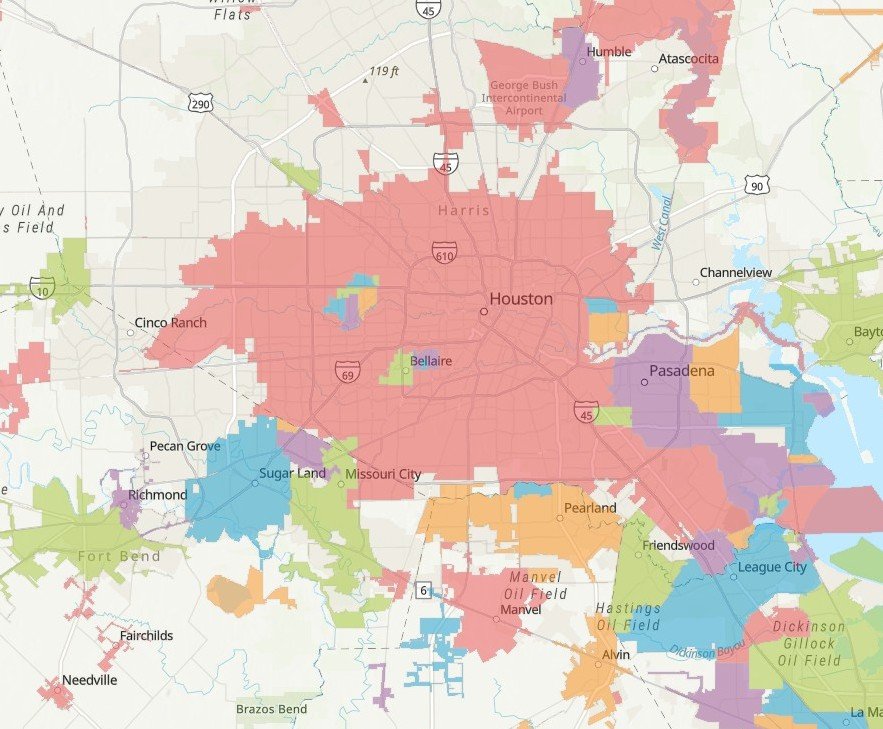
The agency that reviews a Traffic Impact Study depends on the project location, roadway jurisdiction, and access points. In the Houston region, this determination is typically made by confirming city limits, county boundaries, and whether the site connects to a TxDOT facility.
The review agency can usually be identified using the following steps:
- Confirm whether the site is inside an incorporated city: If the project is located within the corporate limits of a city (such as Houston, Sugar Land, Katy, or Pearland), that city is typically the primary reviewing agency for the Traffic Impact Analysis.
- Check if the site is outside city limits but within Harris County or another county: Developments located outside incorporated cities are generally reviewed by the applicable county (e.g., Harris County, Fort Bend County, Montgomery County).
- Determine whether the development impacts a TxDOT roadway: If site access is provided from a state highway, frontage road, or ramp system, TxDOT review is typically required, either as the primary agency or in coordination with the local jurisdiction.
- Identify overlapping or joint jurisdiction cases: Some developments require coordination with multiple agencies, such as a city and TxDOT, or a county and TxDOT, depending on access location and traffic impacts.
- Confirm requirements through agency coordination when needed: For projects near jurisdictional boundaries or with complex access conditions, direct coordination with the reviewing agency is often used to confirm Traffic Impact Analysis requirements.
Traffic Impact Analysis Requirement per Agency
| Agency or Jurisdiction | Peak Hour Trip (PHT) Trigger | Daily Trip Trigger | Required Submittal or Action |
|---|---|---|---|
| City of Houston | 100+ PHT | N/A | Tech Memo (80 – 120) or Full TIA |
| Harris County | 50+ PHT | N/A | TIA Memo; Triggered if >5 acres |
| TxDOT (Houston) | 50 to 150 PHT | 1,000 to 1,500 | Minor Traffic Study (Tech Memo) |
| TxDOT (Houston) | 150+ PHT | 1,500+ | Major Traffic Study (Full TIA) |
| Sugar Land | 100+ PHT | 1,000+ | TIA Worksheet + Full TIA |
| Baytown | 50+ PHT | N/A | City Engineer Coordination |
| League City | Case-by-case | Case-by-case | Summary Screening |
| Missouri City | Case-by-case | Case-by-case | TIA Worksheet (Per IDM Ch. 9) |
| Pearland | Case-by-case | Case-by-case | TIA Checklist + Scoping Meeting |
TIA Houston Frequently Asked Questions
There is no technical difference. “Traffic Impact Study” and “Traffic Impact Analysis” are used interchangeably by agencies in the Houston region to describe the same traffic evaluation process.
TIA requirements depend on project location, trip generation, and roadway jurisdiction. An initial screening or technical memorandum is often used to confirm whether a full Traffic Impact Analysis is required. Civotec routinely performs this applicability review. For screening and preparing a technical memorandum contact Civotec at info@civotec.com.
Reviewing agencies commonly include the City of Houston, Harris County, TxDOT, and surrounding municipalities such as Sugar Land, Pearland, Katy, and League City. Some projects require joint review by multiple agencies.
For low-impact developments, some agencies may accept a Technical Memorandum or abbreviated traffic analysis instead of a full Traffic Impact Analysis. Acceptance depends on trip generation levels, access conditions, and agency discretion.
TxDOT review is typically required when a project accesses or impacts a state highway, frontage road, or ramp system. Even if a city or county is the primary reviewer, TxDOT coordination may still be necessary.
Timeframes vary based on study complexity and agency review cycles. An initial applicability review may take only a few days, while a full Traffic Impact Analysis typically takes several weeks, including agency comments and revisions.
Typical inputs include a site plan, proposed land use details, anticipated opening year, and access locations. Civotec can assist with trip generation estimates and data requirements early in the process.
In some cases, agencies may accept a previously approved Traffic Impact Study if conditions have not materially changed. This determination is agency-specific and often requires confirmation through coordination.
If deficiencies are identified, the study will recommend mitigation measures such as turn lanes, signal timing adjustments, access modifications, or other improvements needed for agency approval.
Yes. Civotec can coordinate with cities, counties, and TxDOT throughout the Traffic Impact Analysis process, including scope confirmation, submittals, and responses to agency comments.
Costs vary depending on project size, study complexity, and agency requirements. A small technical memorandum or initial applicability review typically costs less than a full Traffic Impact Analysis. Full Traffic Impact Analysis, which include data collection, modeling, and agency submittals, are priced based on scope and study limits. Contact Civotec at info@civotec.com for a tailored cost estimate based on your project details.
Agency Thresholds and Requirements in the Houston Region
City of Houston Traffic Impact Study Requirements
For developments within the City of Houston, traffic study requirements are determined by trip generation and project type. The following provides an overview of Traffic Impact Analysis requirements applicable within the City of Houston.
• Access Management Data Summary Form: Required for most developments and redevelopments; exceptions include single-family residences or remodels with no size or use change.
• Technical Memorandum: May be accepted in lieu of a full Traffic Impact Analysis for projects generating approximately 80–120 vehicles per hour (vph) during AM or PM peak periods; typically limited to immediate site access and nearby intersections.
• Full Traffic Impact Analysis (TIA): Required for projects generating 100+ new Peak Hour Trips (PHT); includes background traffic, trip distribution, and study areas typically ranging from ¼ mile to 1 mile, depending on project category.
• View the City of Houston Infrastructure Design Manual and Traffic Impact Analysis Requirements
TxDOT Houston District Traffic Impact Study Requirements
For developments accessing or impacting TxDOT facilities, traffic study requirements are based on trip generation levels and safety and operational impacts. Applicants must first submit a Traffic Study Checklist to determine the required level of study. The following provides an overview of Traffic Impact Analysis requirements applicable within the TxDOT Houston District zones.
• Traffic Study Checklist: Required to determine whether a traffic study is needed and to define the appropriate study level.
• Minor Traffic Study: Required for developments generating 50 to 150 trips in the highest peak hour and less than 1,000 to 1,500 trips per day; typically documented in a Technical Memorandum.
• Major Traffic Study: Required for developments generating 150+ trips in the highest peak hour or 1,500+ trips per day; requires a full Traffic Impact Study report.
• Exempt: Developments generating fewer than 50 trips in the highest peak hour (or fewer than 150 trips in rural areas with low ADT or population).
Harris County Traffic Impact Study Requirements
For developments within unincorporated Harris County, a Traffic Impact Analysis is used to evaluate impacts on the county transportation system. Studies may be prepared as a report or technical memorandum, depending on project characteristics per below.
• Trip Threshold: Full Traffic Impact Analysis typically required for developments generating more than 50 trips during the highest peak hour.
• Size Threshold: Developments greater than 5 acres may require a full TIA.
• Specific Land Uses: Traffic Impact Analysis commonly required for places of worship, schools, industrial warehouses, and major shopping centers (lease space > 100,000 sq. ft.).
• Other Triggers: Traffic Impact Analysis may be required for projects that deviate from county standards, propose major thoroughfares or collectors, are located near unsignalized major intersections, or involve school renovations that alter traffic circulation.
• See Harris County Traffic Impact Analysis Guideline
City of Baytown Traffic Impact Study Requirements
For developments within the City of Baytown, Traffic Impact Study requirements are determined based on trip generation and coordination with the City.
• Agency Coordination: The Engineer of Record is expected to coordinate with the City to confirm whether a Traffic Impact Analysis is required.
• Trip Threshold: A Traffic Impact Analysis may be required for developments generating 50 or more new Peak Hour Trips.
• Permit Submittal: Engineering permit applications must include a sealed plan set and required documentation submitted through the Citizen Self Service portal.
• See Engineering and Development Division Plan Set Requirements
City of League City Traffic Impact Study Requirements
The City of League City uses a data-driven screening process to determine whether a full Traffic Impact Analysis is required. Traffic Impact and Access Management Data Summary Form is required to evaluate permitting concerns and determine if traffic analysis is needed.
• Site Plan Requirement: A scalable site plan showing driveway locations and on-site traffic features must accompany within the form submittals.
• Trip Generation Analysis: Existing and proposed AM and PM peak hour trip rates must be calculated using the ITE Trip Generation Handbook or a City-approved local rate.
• Traffic Impact Analysis Determination: The City reviews submitted data to determine whether a full Traffic Impact Analysis is required.
• Submittal Timing: Forms may be submitted prior to or during Preliminary Plat or Final Site Plan review.
• City of League City Traffic Impact Study Requirement Webpage
Missouri City Traffic Impact Study Requirements
For developments within Missouri City, Traffic Impact Analysis requirements are determined through an initial worksheet review by the City Engineer. A Traffic Impact Analysis Worksheet must be completed and submitted to the City Engineer to determine whether a Traffic Impact Analysis is required.
• Trip Generation Methodology: Trip rates and units must be calculated using the latest ITE Trip Generation Manual or OTISS software.
• Threshold Determination: Traffic Impact Analysis requirements are based on thresholds established in Chapter 9 of the Missouri City Public Infrastructure Design Manual.
• Final Determination: The City Engineer reviews the worksheet and determines whether a full Traffic Impact Analysis is required.
City of Pearland Traffic Impact Study Requirements
For developments within the City of Pearland, Traffic Impact Analysis requirements are determined through an initial traffic screening process. The following provides an overview of Traffic Impact Analysis requirements applicable within the City of Pearland district.
• Traffic Worksheet: Applicants must submit a Traffic Worksheet to estimate generated traffic and determine whether a full Traffic Impact Analysis is required per the Engineering Design Criteria Manual.
• Trip Generation Method: Trip rates are estimated using City-provided values or the latest ITE Trip Generation Manual.
• Scoping Meeting: If a Traffic Impact Analysis is required, a mandatory scoping meeting with the Engineering Department must occur before analysis begins.
• Pre-Development Meeting: Applicants are encouraged to participate in the Pre-Development Meeting process prior to submitting a Traffic Impact Analysis application.
• Traffic Impact Analysis Validity: Approved Traffic Impact Analyses are valid for 24 months.
• See City of Pearland Development and Permitting Guidelines
City of Sugar Land Traffic Impact Study Requirements
The City of Sugar Land uses trip generation, development size, and entitlement requests to determine whether a Traffic Impact Analysis is required per below overview.
• Traffic Impact Analysis (TIA): May be required if a development is determined to have a significant impact on the street system.
• Trip Generation Worksheet: A TIA Trip Generation Worksheet must be submitted with each plat or site plan to determine study requirements.
• Peak Hour Threshold for Performing Full TIA: Approximately 100 trips per peak hour.
• Daily Trip Threshold for Performing Full TIA: Approximately 1,000 trips per day.
• Size Threshold for Performing Full TIA: Developments involving approximately 100 acres or more.
• Other Triggers: Planned Development (PD) requests, Zoning/Rezoning, or Conditional Use Permit (CUP) applications.
• Scoping Meeting: If a TIA is warranted, a scoping meeting with Engineering staff is required to define scope and methodology.
• Letter of Opinion: If a proposed land use is not listed in the ITE Trip Generation Manual, a signed and sealed Letter of Opinion from a professional engineer may be required.
• See City of Sugar Land TIA and Permitting Resources
Jurisdictions Without Published Traffic Impact Analysis Criteria
Some jurisdictions in the Houston region do not publish standalone Traffic Impact Analysis requirements and may reference county criteria, adjacent municipal standards, or TxDOT guidance. In these cases, study requirements are typically determined through coordination with the reviewing authority.
When a Traffic Impact Analysis Is NOT Required
A Traffic Impact Analysis is not always required for every development in the Houston region. Many projects generate low traffic volumes or qualify for exemptions based on agency-specific criteria. In such cases, reviewing agencies may determine that a full Traffic Impact Study is unnecessary.
Common situations where a Traffic Impact Study may not be required include small developments with minimal trip generation, minor tenant finish-outs, changes in use with no net increase in traffic, or projects that fall below established agency thresholds. Some agencies may also waive the requirement when existing traffic studies sufficiently cover the proposed development.
Because requirements vary by jurisdiction, an initial Traffic Impact Analysis applicability review is often recommended to confirm whether a study is required by the City of Houston, Harris County, TxDOT, or other local agencies. Early confirmation helps avoid unnecessary studies and prevents delays during the permitting process.
Technical Memorandum vs. Minor vs. Full Traffic Impact Analysis
Traffic study requirements in the Houston region vary by jurisdiction, and not all agencies formally define multiple levels of Traffic Impact Analysis. In many cases, the reviewing authority determines the appropriate level of analysis based on project-specific impacts rather than fixed study categories. A Technical Memorandum or abbreviated analysis is commonly accepted for low-impact developments with limited trip generation and localized effects. Some agencies may require a Minor Traffic Study for moderate-impact projects, particularly those accessing or affecting state-maintained roadways. These studies include a focused evaluation of peak-hour operations and safety but are more limited in scope than a full TIA. A Full Traffic Impact Analysis (TIA) is required when a development exceeds agency thresholds or creates broader operational or safety impacts. Full TIAs evaluate existing and future conditions, traffic distribution and assignment, intersection and roadway operations, and required mitigation measures.
The required study level is determined by agency policies, roadway jurisdiction, and project characteristics. Early coordination with the reviewing agency is recommended to confirm scope and documentation requirements and to avoid permitting delays.
Steps of a Traffic Impact Analysis
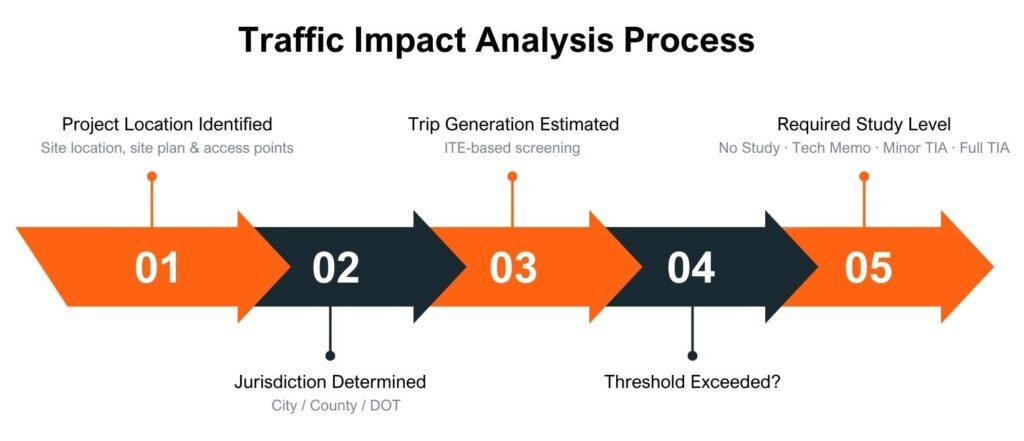
Traffic Impact Analyses are typically completed in two steps. The first step focuses on determining whether a full (or minor) Traffic Impact Analysis is required based on agency criteria and project characteristics. If required, the second step involves completing a Traffic Impact Analysis in accordance with applicable agency standards and review procedures.
Step 1: Initial Traffic Impact Review (TIA Applicability)
- Preliminary Assessment of Agency TIA Requirements: Reviewing applicable Traffic Impact Analysis requirements for the project location to identify the governing agency and relevant thresholds.
- Initial Trip Generation Calculations: Estimating site-generated traffic using accepted methodologies, including the ITE Trip Generation Manual, to evaluate the potential traffic impacts of the proposed development
- Confirmation of Whether a Full Traffic Impact Analysis Is Required: Determining whether a limited analysis is sufficient or if a full Traffic Impact Analysis or Traffic Impact Study is required by the reviewing agency.
- Coordination With Reviewing Agency (as needed): Coordinating with the reviewing agency to confirm study expectations, scope, and documentation requirements when clarification is needed.
Step 2: Full Traffic Impact Analysis (If Required)
- Contracting and Scoping of the Traffic Impact Analysis: Defining the study scope, limits, and analysis requirements based on agency standards and project characteristics.
- Traffic Data Collection (Counts): Collecting traffic volume and operational data at study intersections and roadways to support the Traffic Impact Analysis.
- Traffic Analysis and TIA Report Preparation: Analyzing existing and future traffic conditions and preparing a Traffic Impact Analysis report in accordance with agency guidelines.
- Agency Submittals and Review: Submitting the Traffic Impact Analysis to the reviewing agency and supporting the formal review process.
- Agency Comments and Responses: Addressing agency review comments and revising the Traffic Impact Analysis as required for approval.
Disclaimer
The information provided on this page is intended as a general overview of Traffic Impact Analysis requirements in the Houston region. Requirements, thresholds, and procedures may vary by jurisdiction, project characteristics, and over time. This content should not be relied upon as a substitute for official agency guidelines or direct coordination with the reviewing authority. Final study requirements are determined by the applicable reviewing agency.
How can we help?
Submit your project details to receive a tailored traffic engineering proposal with a typical turnaround of 24 hours.